
China contributes the largest number of students to international schools in China and the world. The key drivers behind this inclination are a burgeoning middle class and a great appetite among 260 million Chinese students and their parents for a well-rounded, globally-focused education. Therefore, international schools require a robust marketing and promotion strategy to attract Chinese students. This comprehensive article delves deeper into the international education market in China and the key factors behind its growth. Moreover, it presents a data-driven education marketing guide for China to promote an international school and attract Chinese students.
Key Facts:
- More than one out of every six students studying abroad are Chinese.
- China has the second largest number of overseas schools, following the United Arab Emirates.
- The increasing household income in China leads more families to send their children abroad for studies.
- A survey of young Chinese returnees studying abroad shows that cultural experience was a major motivating factor for four-fifths of them. At the same time, a third were influenced by job market competitiveness.
Education in China
China boasts the world’s most extensive education system, with 293 million students, 18 million teachers, and 518,500 schools. An impressive 99.83% literacy rate is the epitome of the importance of education in China. The Chinese government is trying to provide high-quality free education to millions of students to uphold academic excellence.
The Chinese education system includes nine years of mandatory education, i.e., six years of primary and three years of middle school. After completion, students can choose a high school diploma or join the workforce. Since high education in China symbolizes social status, most students strive for a university degree from a globally recognized institute. To secure admission to a high-ranking university, parents now prefer admitting their children to international schools in China over government schools to inculcate creativity, critical thinking skills, and exposure to global education.
China’s International Education Market: A Booming Landscape
The international school industry in China has witnessed significant growth over the years. International schools increased from 1,200 in 2002 to over 12,000 in 2022, highlighting Chinese students’ ever-growing demand for international education. The key drivers behind this growth and the diverse landscape of China’s international education market are discussed below:
Government Support:
The Chinese government has introduced flexible policies for international schools to fulfill the need for diverse education pathways for millions of students. China now offers a favorable environment for any international school brand to enter and provide a Western-style education system.
Middle-Class Aspirations
Due to the growing economy, the surplus income of Chinese households, especially in the middle class, has exponentially increased. Parents from this socioeconomic background also see education as a means to social mobility. They want to provide their children with world-class education, English language skills, and exposure to Western cultures.
Program Diversity
International schools provide a wide range of educational programs to meet the various needs of their students. Established alternatives include A-Levels (UK), AP (US), and the internationally acclaimed IB curriculum. Furthermore, the DSE program for Hong Kong colleges is gaining popularity in mainland China. This set of programs enables Chinese students to prepare for admission to colleges worldwide.
Beyond National Borders
Domestic demands only partially drive the foreign education market in China. The growing dominance of English as a commercial language and the rapid growth of academic mobility in higher education are also crucial factors. An internationally recognized education from a Chinese international school equips students with the skills and qualifications to succeed in a worldwide workforce.
Regional Growth
The boom of international schools is now not limited to China’s metropolitan cities only. The first-tier cities have more international schools, but due to their strict admission policies and low approval rates, students are now shifting to international schools in second-tier cities. Therefore, underdeveloped areas in the southwest, northwest, and northeast have enormous potential for an overseas school brand to fill this gap.
Overseas Chinese Students
China has the most overseas students studying abroad in various countries. The largest international students in the US and Australia have been Chinese overseas students for over a decade. Other emerging destinations for international education are Italy, Ireland, Spain, Sweden, Switzerland, Singapore, Malaysia, Thailand, Russia, and Belarus. These Chinese students prefer going to international schools to gain global exposure, learn about various fields of knowledge, and engage in cross-cultural exchanges.
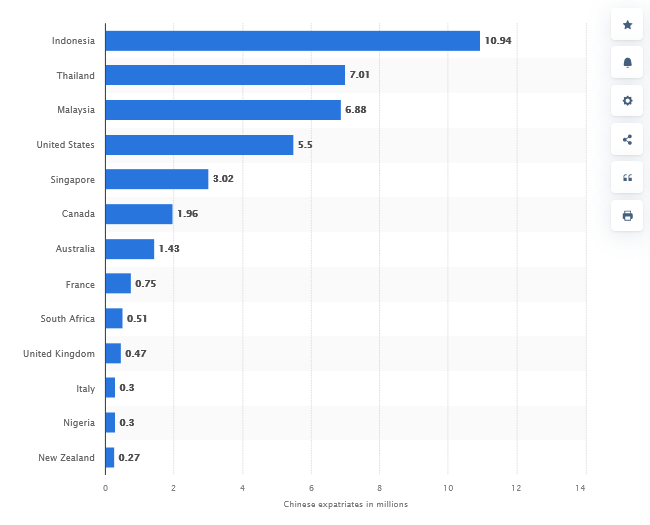
Statista: Selected countries with the largest number of overseas Chinese in 2022 (in millions)
Overall, China offers a favorable environment and exciting opportunity for international educational institutes to satisfy the rising demand for quality global education. Any International school aiming to capitalize on this potential should provide a curriculum that combines Chinese qualifications with a concentration on English language skills, internationalization, and Western values.
Type of International Schools in China:

Reasons Why Chinese Students Prefer International Education
China’s education system is known for its rigorous standardized testing and emphasis on rote learning methods. Chinese students are more inclined towards international education because it offers diverse subjects, learning routes, and professional training to enter the job market. These students are discouraged by nerve-wracking entrance exam pressure and overemphasizing STEM fields.
A Shift Towards Holistic Learning
According to a survey, 81% of Chinese respondents prefer studying abroad due to the exposure to culturally rich experiences and a holistic lifestyle. To cater to this growing need, international schools aiming to succeed in China should focus on providing extracurricular activities to stimulate personal development, critical thinking, creativity, and skill development.
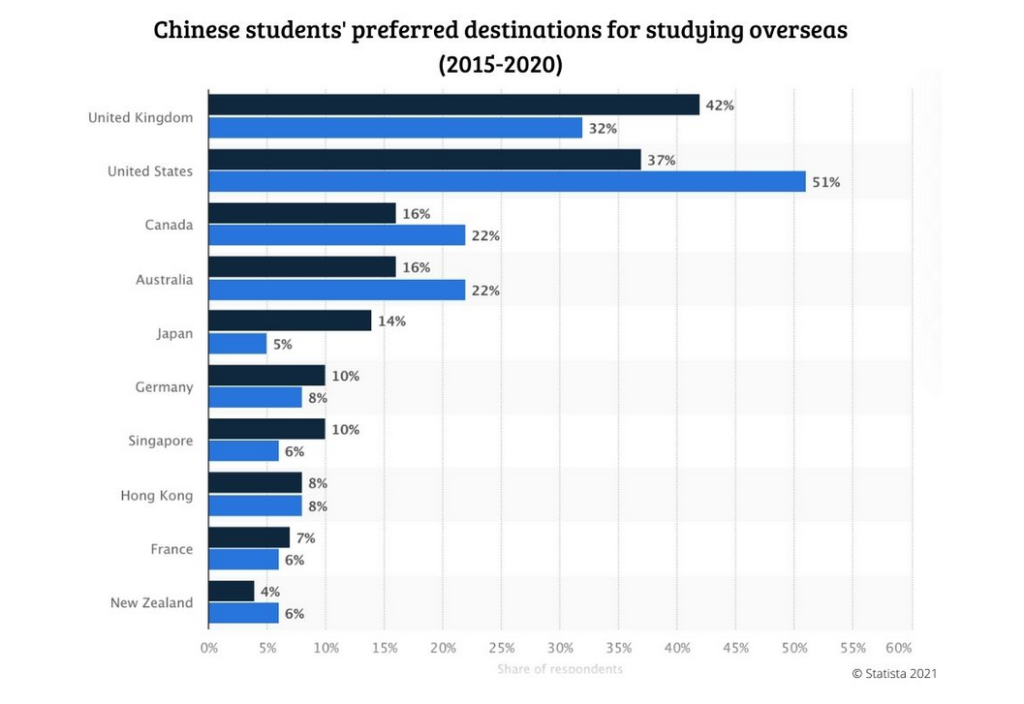
Escaping the Gaokao Pressure
The “Gaokao,” China’s challenging university entrance exam, stresses candidates and their families enormously. International schools relieve this burden by offering various curriculums such as A-Levels, AP, and IB programs. These programs provide alternative avenues to colleges globally, avoiding the single concentration on the Gaokao.

In 2023, 13M Chinese students took the Gaokao exam.
Dissatisfaction with the Public System
China’s growing middle class seeks enriched and quality education for their children. Many parents believe the public education system needs more creative thinking, critical analysis, and foreign language skills. They prefer sending their children to International schools in China to instill these qualities.
Global Exposure and Career Opportunities
International schools prepare Chinese students to join world-leading educational institutes and have a higher chance of entering the global market in the future. Chinese students from international schools are fluent in English, are well-versed in international exam styles, and feel more comfortable in culturally diverse environments.

“On average, Chinese children spent 8.1 hours at primary school on weekdays”
The confluence of several factors, namely a growing middle class, dissatisfaction with the public education system, Gaokao fatigue, and a dream of a world-recognized international degree, is driving the demand for international education in China. With diverse curriculums, holistic learning styles, and a focus on personal development, international schools have a higher competitive edge over public schools in China.
Understanding the Target Audience of International Education Market in China

China’s emerging middle class significantly contributes to the surge in demand for the international education market. Schools need to delve deeper than the surface-level traditional marketing strategies to gain a foothold in China. The only way to succeed is by understanding students’ and families’ unique expectations and concerns.
Meeting Parental Expectations:
Though academic excellence remains important, Chinese parents now want an all-around education that nurtures their children’s critical thinking, creativity, and worldly outlook. This skill set is required to enter top universities and have better career prospects. However, parents feel they need more support to pursue a global degree program due to the financial costs and the possibility of cultural alienation. To ease these pain points, schools should share success stories of Chinese alums who did well in their schools and showcase a commitment to cultural inclusivity.
Understanding Student’s Aspirations:
Chinese students strive to study at world-renowned universities. They feel constant stress about the lack of focus on critical thinking skills and independent learning habits in public schools. However, they also need help getting accepted at an international school due to the prominent language barrier. Social integration is another known concern among Chinese students. International schools should build a diverse student body with cultural programs to highlight the welcoming and inclusive nature to attract Chinese students from all regions.
Thus, international schools should tailor their message to create a compelling value proposition suitable for students and their parent’s unique needs.
Winning Strategies for International Schools to Successfully Attract Chinese Students
Market Study
International schools require a thorough market research study to understand the evolving dynamics of the education sector in China. A market study provides insights into the latest trends in the education industry, students’ and parents’ needs, and competitor analysis to make better data-driven strategies for school marketing in China. To position the school better, the organization should conduct a market study that covers the following aspects:
- Understanding the target audience and their aspirations
- Evaluate the local or regional competition
- Information about rules and regulations
- Provide a unique value proposition based on data
- A 360 marketing plan for offline and digital channels.
Website Localization
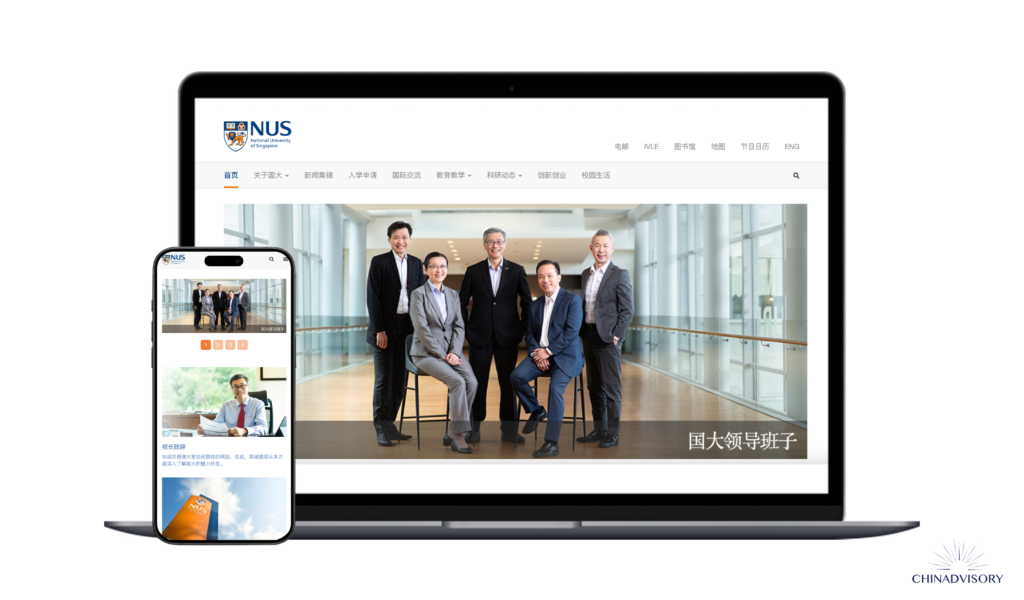
“Website localization is modifying an existing website to make it accessible, usable, and culturally suitable to a target audience.” International schools should localize their website interface and content to promote to Chinese students and parents effectively. It includes translating the website into Chinese and adding culture-appropriate imagery.
For a more effective digital user experience, international schools must focus on the following areas:
1. Website Hosting:
Schools must partner with local Chinese web hosting services for seamless and speedy web browsing. It will increase the website loading speed within China’s Great Firewall.
2. Website Design
The majority of Chinese students prefer browsing through their phones. Ensure the school’s website is mobile-friendly and responsive for optimal viewing and functionality on all devices. Opt for a clean and minimal website design. Provide an easy-to-use website navigation structure for parents with non-technical backgrounds as well. Keep all the necessary information on the homepage.
3. Keyword Research & SEO for Baidu
Ensure the school’s website incorporates these keywords and search phrases in the content. For better SEO optimization, create blog posts using short and long keywords on the website. Write keywords in URLs, meta descriptions, and tags to rank higher in the search results on Baidu.
To rank higher in local listings, create a local SEO strategy targeting local keywords related to the school and its location. Make sure the school is listed in all online directories and listings.
4. China Online Advertising
International schools in China should leverage online advertising on Baidu and other social platforms such as WeChat, Douyin, and Weibo. These platforms provide precise audience segmentation and highly targeted ads, allowing schools to create personalized ad campaigns to target specific demographics in specific locations.
International schools must craft compelling creatives and ad campaigns that evoke trust, credibility, and a positive reputation among students and parents. Online advertising is a proven effective marketing strategy in China’s digital landscape for attracting students to international schools.
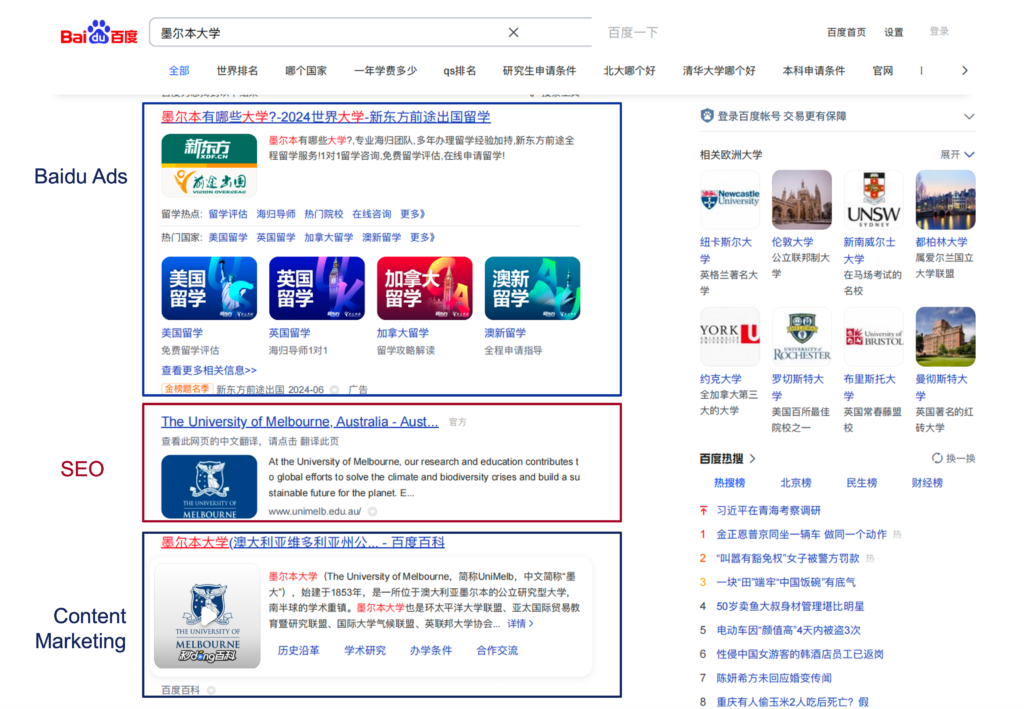
Baidu Searching Result for The University of Melbourne (墨尔本大学) Page 1
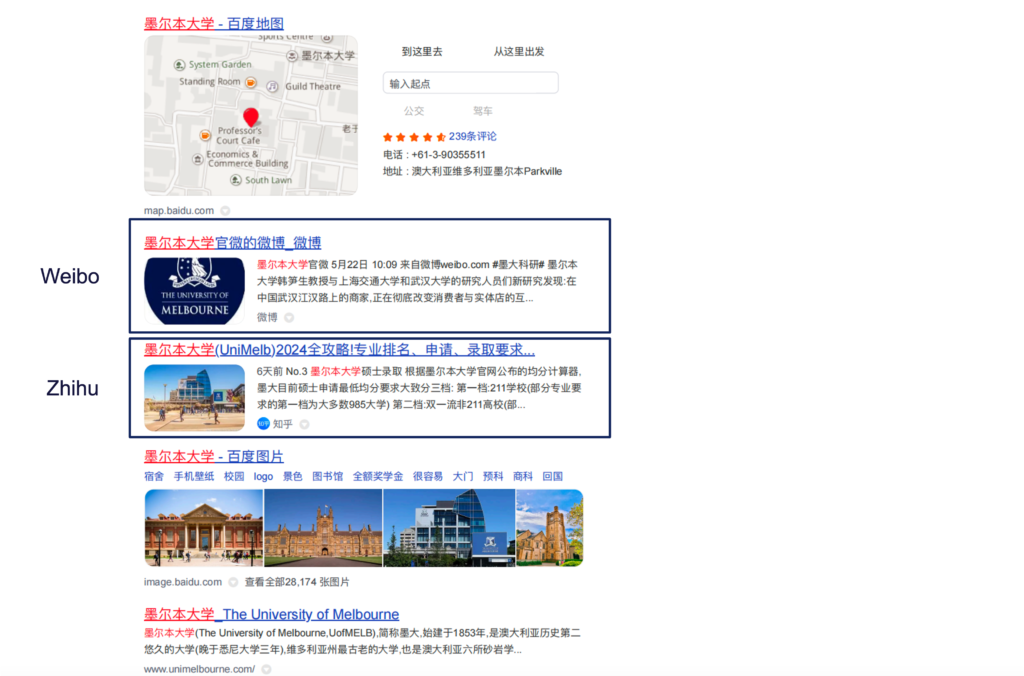
Baidu Searching Result for The University of Melbourne (墨尔本大学) Page 2
Establishing a Robust Online Reputation
Besides web optimization and online advertising, building a positive online reputation in social media and education platforms is crucial. The aim should be to establish the school name as reliable and trustworthy in its major category among Chinese students.
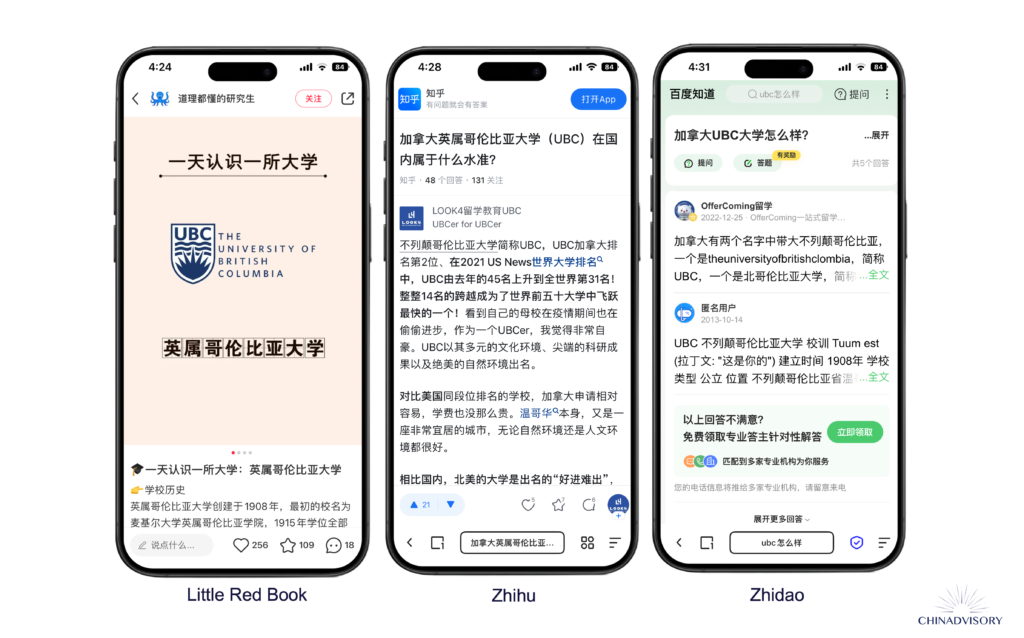
Chinese Forum Discussions about the University of British Columbia
1. Alumni Success Stories
One of the most convincing factors in attracting Chinese students is highlighting Alumni success stories across digital platforms. Schools should showcase how their education transformed these students’ lives and helped them achieve their aspirations. These success stories inspire other Chinese students and parents and increase trust in the school.
2. Exchange Programs
Exchange programs allow Chinese students to experience the quality of education and the school’s learning environment. It is the best way to foster a deeper connection between students and school. It also promotes the school through positive word of mouth. Exchange program students become advocates of the school, and the school utilizes their testimonials in marketing and advertising campaigns.
3. Financial Aid to International Students
Schools should offer financial aid programs for talented students from diverse backgrounds who may be unable to afford total tuition fees or school expenses.
4. Partnership with Local Schools
Another successful way to build a high reputation and credibility is to partner with reputable local schools in China. International institutes should organize seminars, workshops, and other educational events at local schools to increase brand recognition among potential students and their families.
Maximising Social Media Impact
Chinese students spend their free time on social media platforms, and they use these platforms to discover the schools, gather information, and engage with the school community. Utilize the following social media platforms with strategies to attract hundreds of these potential students.
1. WeChat
All local and international schools use WeChat’s official account as their primary communication channel to contact their students. They create informative articles about educational tips, career counseling, student success stories, alumni news, etc. The WeChat group is another valuable feature for overseas schools, providing instant information to current and prospective students. WeChat also allows schools to host virtual events such as campus tours, workshops, Live Q&A sessions, faculty interviews, etc.
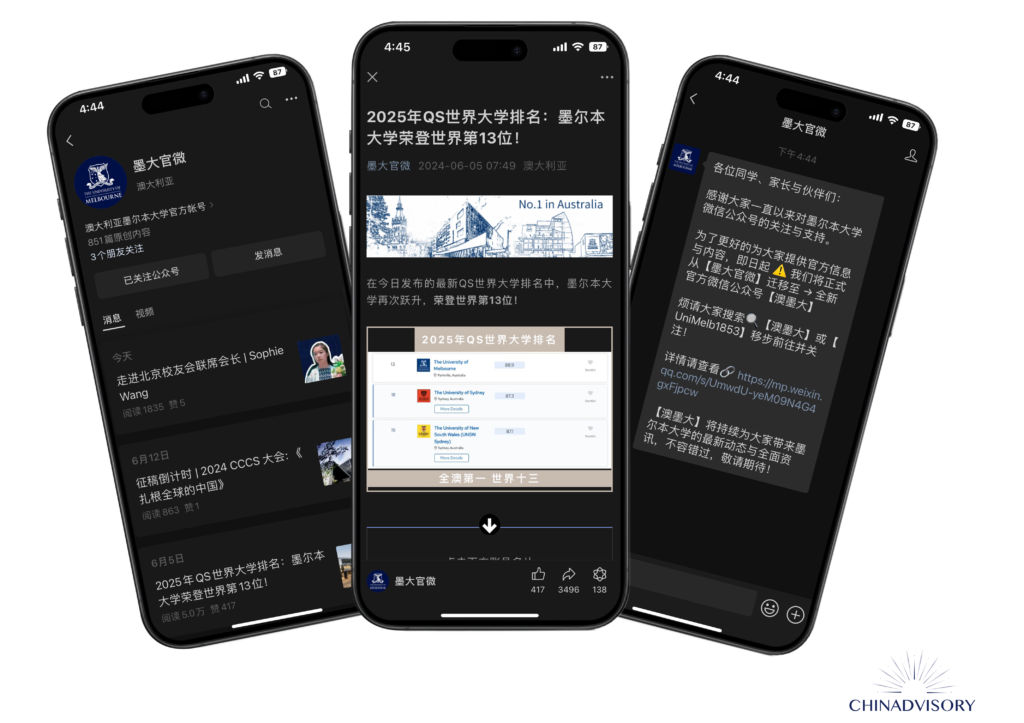
Official WeChat Account of The University of Melbourne
2. Douyin
Millions of Chinese students use Douyin daily to watch informative and educational content. As an overseas school in China, we create relatable content for Gen-Z students to build an online community consistently. The content must showcase the school environment, events, and learning opportunities. Partner with Douyin influencers to promote the school relatable and authentically to their younger audience.
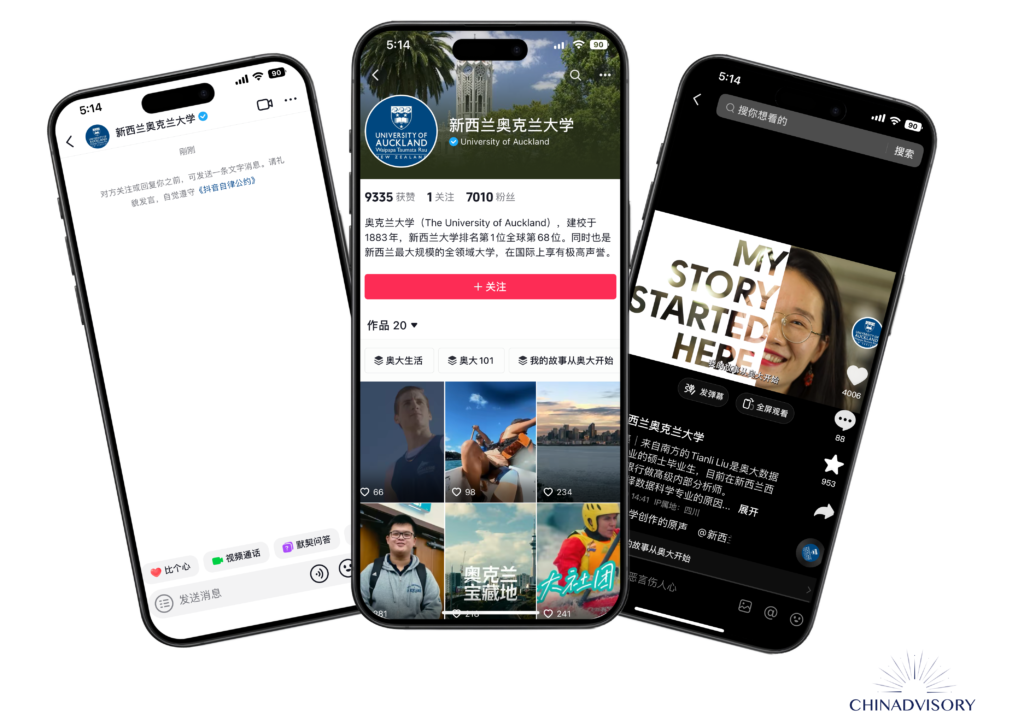
Official Douyin Account of The University of Auckland
3. Xiaohongshu
Xiaohongshu is another top-rated social commerce platform among Chinese students. To reach the Xiaohongshue audience, create an official account and share daily snippets of school life. Schools should create relatable content, such as their students’ routines, co-curricular activities, and school events, for prospective students and earn a positive brand image on the platform.
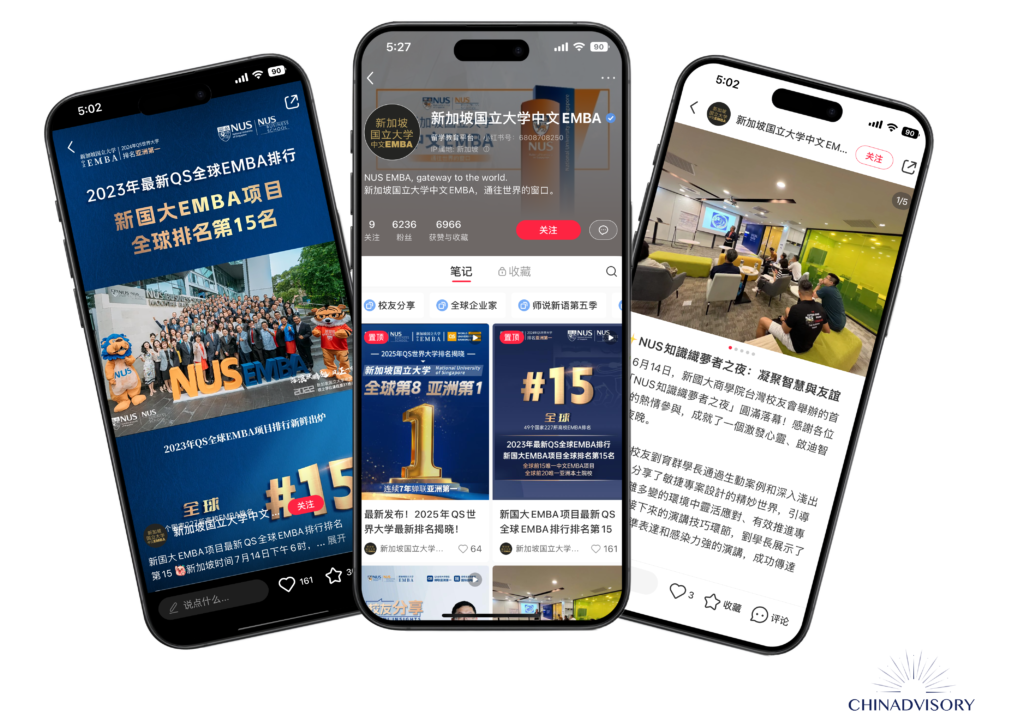
Official Xiaohongshu Account of the National University of Singapore
4. Weibo
Weibo is the ultimate option for disseminating news and information about the school. Utilize this platform to immediately share news about admission cycles, scholarship offers, events, and other time-bound activities with the prospective audience.

5. Bilibili
Bilibili is a video-sharing platform that creates relatable content for prospective students. Schools should create informative series around educational topics featuring international students to attract Chinese students to the school. Leverage Bilibili influencers’s social power to market the school content to their followers.
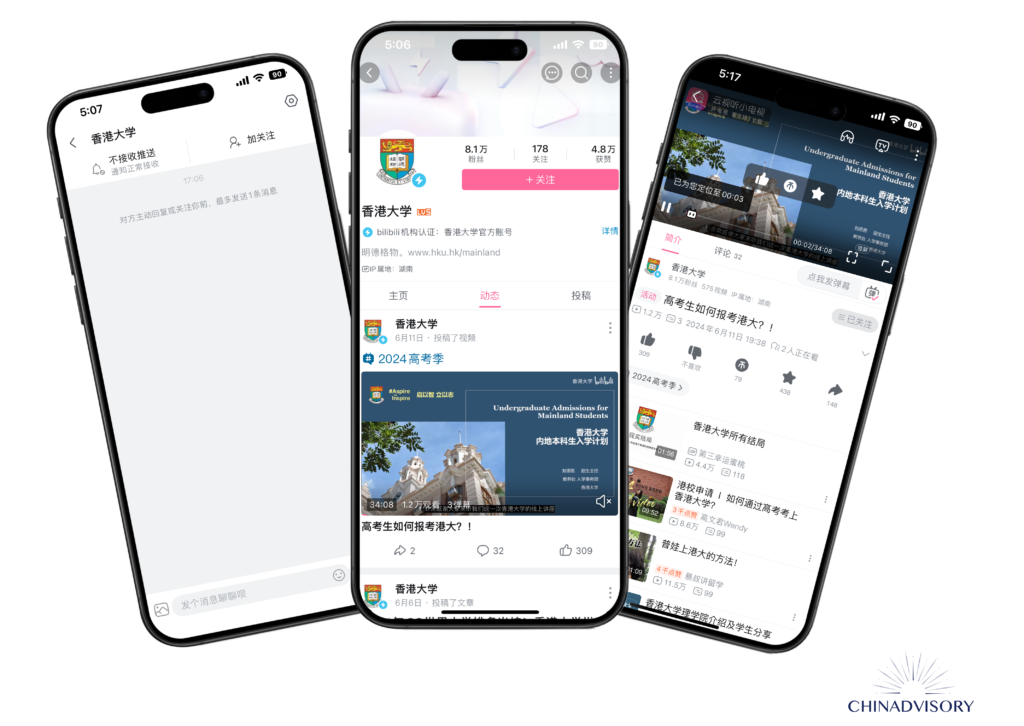
Official Bilibili Account of The University of Hong Kong
Conclusion
The international education market in China is snowballing and holds great potential for overseas schools to thrive and earn top positions in the education industry. To successfully attract Chinese students, an international school should build a good reputation, trust, and credibility through strategic marketing strategies infused with cultural appropriateness.
Chinadvisory | Your Reliable China Education Marketing Partner

More than 12,000 international schools compete daily to gain the attention of Chinese students and parents. Chinadvisory is here to make you stand out in this competitive arena and establish your reputable position in the international education market in China. We specialize in helping international schools in all stages of engagement and marketing in China, from market entry strategy to marketing campaigns and local partner management.
Our expertise in education marketing allows international schools to thrive in China’s education market and devise data-driven marketing strategies for offline and online platforms. Additionally, we will help you utilize diverse digital marketing tools to reach target segments and foster a thriving community of Chinese students at your school.
Contact us to learn how Chinadvisory can help you develop a customized data-driven China marketing plan for your international school.